Who Will Unearth Our Evolutionary Stories?
Scientists recently discovered 88 fossilized human footprints in the Utah desert at a US Army military training and test site. They believe these tracks were made by adults and children who walked along a shallow riverbed in the late Pleistocene era, more than 12,000 years ago. At the time of their discovery, archeologists were searching the desert for sites of ancient fires.
I.
In a northwest Utah desert, a group of ancestors
once walked barefoot through a riverbed. As they
moved, ancient galaxies overhead formed cartwheels
of dust, diamonds, diaphanous rainbow-hued gases.
Scientists estimate their steps were taken twelve
thousand years ago. This desert is dry now, spare
as a bison skull. Back then, lapis lazuli rivers rippled
and canyons grew thick with fronds of emerald foliage.
They gathered reeds for baskets, planted corn, squash, beans,
made fires to equal sunset’s blazing skies where quail, rabbits
were roasted at day’s departure. Perhaps prayers were offered
for wisdom as they followed stars travelling overhead.
II.
Today, I realized with a start, that more than twelve years
had passed since our nearby small reservoir was decommissioned.
This former water source has now birthed its own island,
kudzu vines, deciduous trees, goldenrod, wild purple phlox.
Beavers are constructing a dam to shore. A stately grey heron
has stopped by to watch as packs of ducks paddle amidst new
grasses. Two bald eagles hug spare limbed pines. They hunt as
dusk envelops an evolving continent like a super-hero’s cloak.
Even in the midst of a climate emergency, an evolutionary
microcosm has shaped before our eyes. It feels as timeless, urgent
as the blood orange moon that fills these August skies. One day,
another family will walk where bluebird-hued water once reigned.
III.
Archeology students in Kingston, New York just uncovered
remains of former slaves in a shallow churchyard gravesite.
Adults, an infant, a child, aged three. Bleached bones buried,
forgotten, unknown, beneath dust, dirt, patches of grass,
at rest for perhaps three hundred years as a small city grew
up around them. In Manhattan, slave burial grounds lie beneath
skyscrapers and courthouses. Most city dwellers pass overhead
without knowledge, interest. Without recognition or regret.
The students, however, understood the value of what they had
exhumed. They soon conducted formal ceremonial burials.
Tenderly, as a relative might, each bone fragment was wrapped
in cloth, adorned with rose petals. Spirituals rose up like blackbirds.
IV.
The Colorado River is drying up. Lakes Mead and Powell mere
shadows of their former beauty. Each day, bodies of old tractors,
trucks, boats, humans come unburied, poke out of greying gullies,
bleached, beached like lost whales. Hydroelectric dams will soon
lose power to fill faucets, hydrate farmlands in seven western states
and Mexico. Crops shrink. Fields lie fallow. Once revered as life source,
vital fluids drain away, drip by drip, leak by leak. The Great Salt
Lake disappears before our eyes, sending arsenic dust into dry air.
No one likes the outcome, yet no one wants to act. In ancient times,
settlers moved on when droughts came. Pictographs of their lives
remain at Chaco Canyon and Mesa Verde where tourists climb
ancient ladders, peer into cliff-side villages, ceremonial kivas.
V.
New droughts have parched cornfields, thinned grassy meadows
to straw stick figures. Even pigweed struggles in unrelenting heat.
Our small creek’s residents have been reduced to granite slabs,
piles of greying stones. No one behaves by the usual rules.
Bears wander into kitchens as if someone invited them to tea.
They turn doorknobs, pull windows from sills, topple dish-filled
wooden cabinets, leave muddy prints behind. Just now, a scarlet tanager
sat down on our driveway, as if the very idea of flight was too exhausting.
Every now and then, he tried to lift up his wings, then shook his head,
stayed put as curled leaves fell like old memories. I grew tearful,
as I wondered how his story might unfold, but tears dried before they formed.
Even our old turtle is hiding, his stories buried deep within his mottled shell.
VI.
Beneath every footstep, another set of footprints awaits discovery.
A broken jar worn smooth by wind, sea, time. A nest recycled
from last year’s scraps of twig, bone, feather, ribbon, string.
A rusted metal fragment of an old tractor. A saw’s jagged edge,
still sharp enough to draw blood. A jumble of bluestone rocks
that once formed a perfect boundary wall call to us like sirens.
Last year, I searched for my father’s whitened gravestone amidst
Arlington’s legendary rows. Its numbers and letters revealed
little that could shed light on our brief, star-crossed journey.
His grandfather fought for the Union Army at Antietam. Who
knows where those remains might be found. Maybe it is best
to scatter ashes at water’s edge, watch them drift off like seabirds.
VII.
History remains harder to erase than one might expect.
Neanderthal remains found in a Siberian cave are bound
by DNA. One can almost hear that father as he whispering
a lullaby to his young daughter just before their world collapsed.
We have always been transfixed by migration stories.
Each evening, celestial celebrations take place amidst
a cosmos we have been trying to chart for centuries,
long before Ptolemy’s Almagest catalogued visible stars.
Mirrored telescopes can now transmit infrared beams of light
back to earth in hopes past destinies might inspire a future.
If luck holds, our own fossilized footsteps will one day emerge
to future explorers huddled fireside beneath somersaulting stars.
Mary K O’Melveny, a happily retired attorney,is the author of four poetry collections and a chapbook. Her most recent, If You Want To Go To Heaven, Follow A Songbird (Jerry Jazz Musician 2024) is an album of poems, art and music available at Jerry Jazz Musician. Mary’s award-winning poems have appeared in many print and online literary journals and anthologies and on international blog sites. Mary’s collection Flight Patterns was nominated for the Eric Hoffer Book Award. Her book, Merging Star Hypotheses, was a semi-finalist for The Washington Prize, sponsored by The Word Works. Mary has been twice nominated for a Pushcart Prize. She is an active member of the Hudson Valley Women’s Writing Group and her poetry appears in the Group’s two published anthologies, An Apple In Her Hand and Rethinking The Ground Rules. Mary lives with her wife near Woodstock, New York.
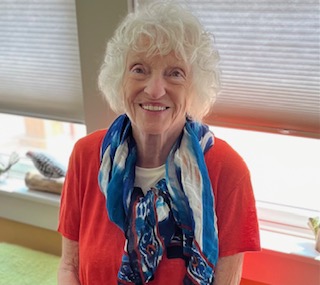
 the poet's billow